
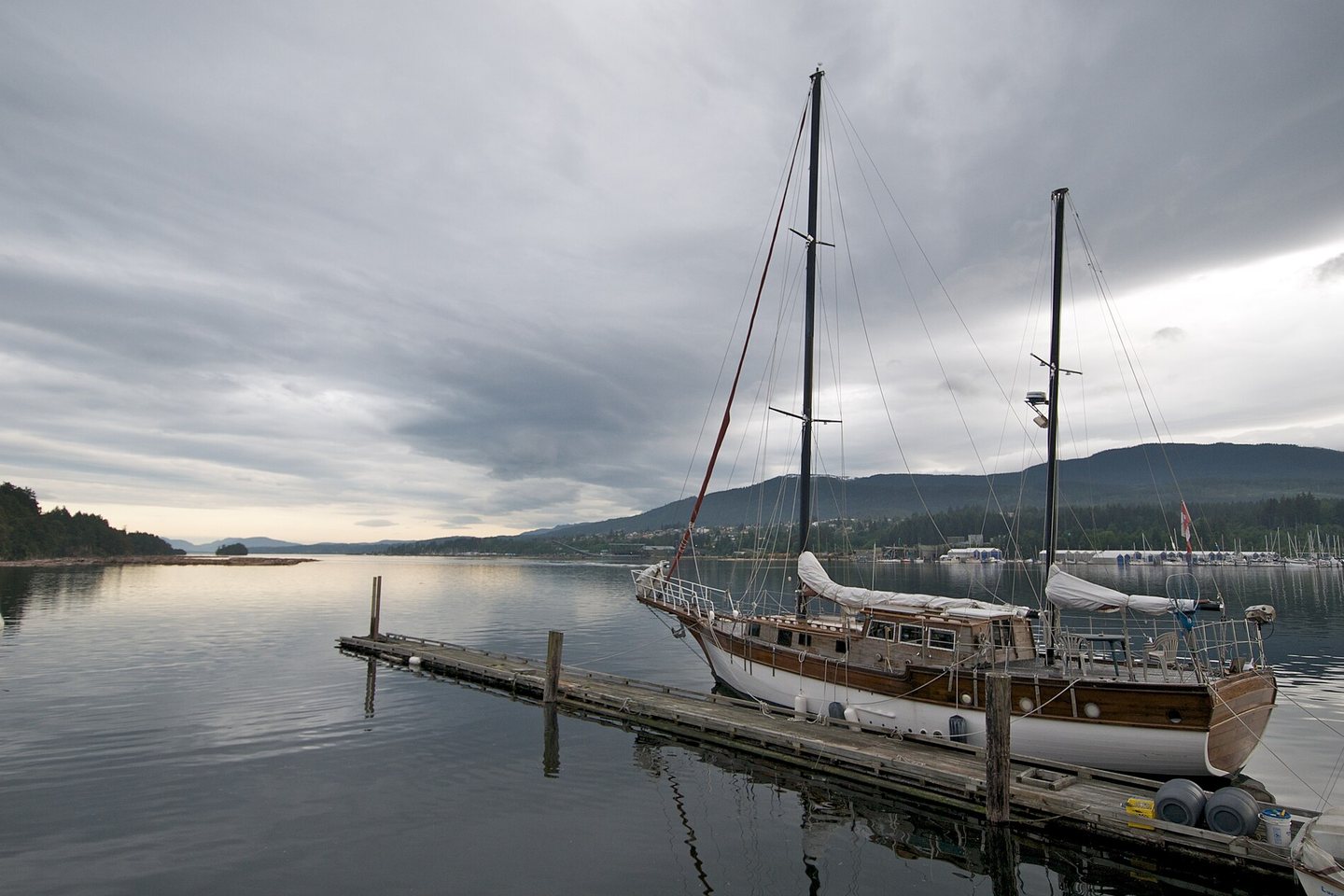

Houses above the harbour
Ladysmith is built on a slope. Roofs point downhill toward the harbour or uphill into the next street. The downhill face takes the weather you can see. The uphill face takes needles. Asphalt covers most of them. A lower roof over an entry or a later bathroom meets the wall and leaks there first.
First Avenue and the commercial strip are not the house roofs on the hill. If your leak is in a shop with a low roof, say shop. If it is a bedroom in a house, say house. The materials are different.
A thick shingle edge means a second layer. A pale edge means the layer you see is tired. You can tell from the sidewalk. Say which one you have so the visit is aimed correctly.
Wet winters
Rain lasts for weeks. Moss grows on shade. It is not, by itself, a reason to strip the roof. Needles packed in a valley are a reason for a stain, because they hold water against the laps. If you can see the valley from the uphill street, look into it.
Wind off the harbour reaches the lower streets and lifts edges. Upper streets lose fewer tabs and grow more moss. After a storm, a walk around the house tells you which kind you are.
Snow is uncommon and light. A cold week can ice the eave of a warm attic. The stain then follows the outside wall. A circle in the middle of a bathroom is the vent, in any season.
Say it so the stop fits
Ladysmith first, so this is not treated as Chemainus or Saltair. Then the street. A house below the road and a house above it need different photos, because you can see the uphill slope only from above.
Narrow side yards are normal. Say if the ladder has to stand on the next path. Say if a retaining wall is under the wet eave.
Photos from the ground and a description of the ceiling mark are the preparation. Stay off the roof. Mention tar at the chimney if a smear is already there.
Around the house
Transfer Beach is the landmark at the bottom of the hill. Roofs down there see more wind. Roofs up by the school see more trees. Use the landmark you actually live near, in ordinary words, so the stop is on the right part of the hill.
Many chimneys in the old town have been repointed and the flashing was not. A neat chimney with a stain beside it is still a flashing leak. Say the brick looks tidy and the ceiling does not. That keeps the visit on the metal, not on a rebuild of the chimney.
If the only parking is the street and the street is narrow, say narrow. A truck with a ladder rack needs that sentence before it arrives.
Older porches that were glassed in still have the original low roof. The glass did not fix the joint at the wall. If the sunroom is the wet room, say sunroom. The gable above can stay out of the conversation until someone has looked at the joint. Boulevard trees on the flatter streets plug gutters in October. A house you just cleaned that leaks again is no longer a leaf problem.
Sources: Local maps of Ladysmith.
Questions
What should I notice first?
Whether the wet room faces down toward the harbour or up into the trees, and whether the gutter on that side is full.
How old are these roofs?
The town has a lot of older houses. Some slopes are pale and curled. Some were replaced and still look dark.
What do I say on the call?
Ladysmith, the street, the wet room, and harbour side or tree side.
How much does roof repair cost in Ladysmith?
Cost depends on the roof size, layers and access. A small leak repair is a different quote than a reshingle. Call (778) 901-9799 and the roofer gives a number after hearing what is wet.
How fast can a roofer come out in Ladysmith?
Emergency leaks get priority. No one can promise a same-day visit. Water already inside at Ladysmith belongs on emergency roof repair.